Year
Pending
Client
AutoRob Lab Georgia Tech
Category
VR/AI
Role
Product Engineering
Year
Pending
Client
AutoRob Lab Georgia Tech
Category
VR/AI
Role
Product Engineering
Year
Pending
Category
VR/AI
Client
AutoRob Lab Georgia Tech
Role
Product Engineering
Overview
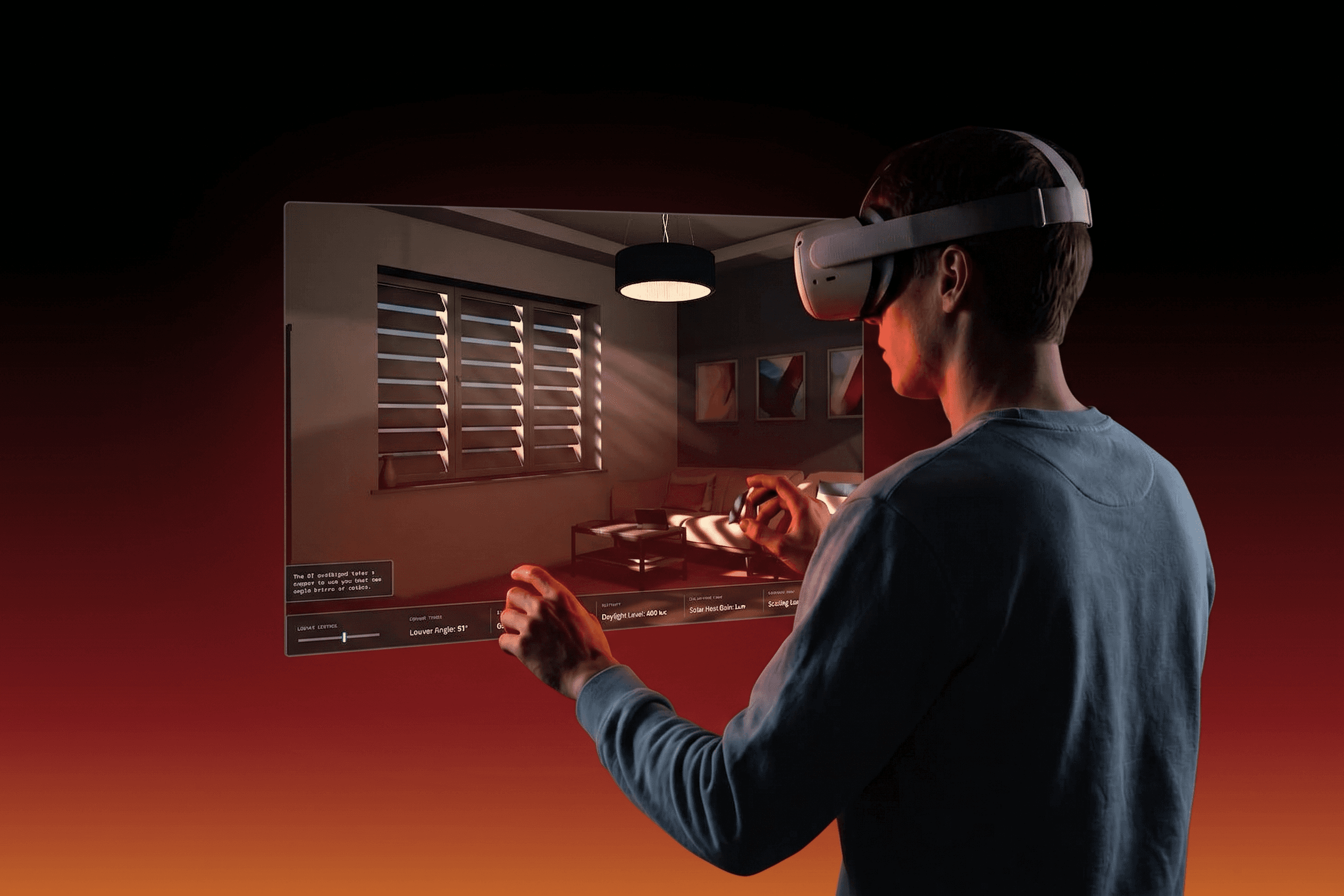
VRAPS is a VR platform that teaches sustainable building design by placing the user inside the structure. Users navigate the space in a headset while an AI voice explains the architectural decisions behind their current focus.
Note: This page is a placeholder. The full case study will be published when the first VR build is complete.
Overview
VRAPS is a VR platform that teaches sustainable building design by placing the user inside the structure. Users navigate the space in a headset while an AI voice explains the architectural decisions behind their current focus.
Note: This page is a placeholder. The full case study will be published when the first VR build is complete.
Overview
VRAPS is a VR platform that teaches sustainable building design by placing the user inside the structure. Users navigate the space in a headset while an AI voice explains the architectural decisions behind their current focus.
Note: This page is a placeholder. The full case study will be published when the first VR build is complete.
Bete Showcase (AI Voice Feedback)
Research Context
The AutoRob Lab researches VR and AI for construction education and workforce development, supported in part by the National Science Foundation.
My contribution is the VR build, not the study design. However, the build must function as a strict research instrument. It must be consistent, repeatable, and realistic so that participant feedback reflects the architecture, not the graphics.
Research Context
The AutoRob Lab researches VR and AI for construction education and workforce development, supported in part by the National Science Foundation.
My contribution is the VR build, not the study design. However, the build must function as a strict research instrument. It must be consistent, repeatable, and realistic so that participant feedback reflects the architecture, not the graphics.
Responsibilities
My role is to design and engineer the environment and the interaction. In practice, this requires:
Rebuilding the architectural model from a Revit export into a real-time engine.
Calibrating materials and lighting to match real-world counterparts.
Designing spatial navigation and movement mechanics for VR headsets.
Wiring the AI voice layer to respond dynamically to user gaze.
Responsibilities
My role is to design and engineer the environment and the interaction. In practice, this requires:
Rebuilding the architectural model from a Revit export into a real-time engine.
Calibrating materials and lighting to match real-world counterparts.
Designing spatial navigation and movement mechanics for VR headsets.
Wiring the AI voice layer to respond dynamically to user gaze.
What I Learned [SO FAR]
Realism in research vs. gaming: A game can fake lighting to improve a scene's mood without consequence. In a research tool, if a material reads incorrectly, the participant's response becomes unusable data.
Differing visual priorities: Architects and game designers evaluate renders differently. The building's architect reads a render for material honesty and daylight behavior. I was trained to evaluate silhouette and composition. Adapting to her perspective changed my workflow.
Ownership over shortcuts: I inherited a functional build written by a more experienced engineer, but I chose to rebuild it. On a tool used for human studies, the inability to explain your own system is a defect, not a shortcut.
What I Learned [SO FAR]
Realism in research vs. gaming: A game can fake lighting to improve a scene's mood without consequence. In a research tool, if a material reads incorrectly, the participant's response becomes unusable data.
Differing visual priorities: Architects and game designers evaluate renders differently. The building's architect reads a render for material honesty and daylight behavior. I was trained to evaluate silhouette and composition. Adapting to her perspective changed my workflow.
Ownership over shortcuts: I inherited a functional build written by a more experienced engineer, but I chose to rebuild it. On a tool used for human studies, the inability to explain your own system is a defect, not a shortcut.
What I Learned [SO FAR]
Realism in research vs. gaming: A game can fake lighting to improve a scene's mood without consequence. In a research tool, if a material reads incorrectly, the participant's response becomes unusable data.
Differing visual priorities: Architects and game designers evaluate renders differently. The building's architect reads a render for material honesty and daylight behavior. I was trained to evaluate silhouette and composition. Adapting to her perspective changed my workflow.
Ownership over shortcuts: I inherited a functional build written by a more experienced engineer, but I chose to rebuild it. On a tool used for human studies, the inability to explain your own system is a defect, not a shortcut.
AI Voice Layer
A dual-AI pipeline generates spoken feedback based on user interaction.
Audio over text: The assistant speaks to keep the visual interface clear of text blocks.
Live generation: Current spatial readings are sent to Gemini, which drafts a single-sentence summary. ElevenLabs then synthesizes the speech.
Timing: The system waits for the user to settle on an angle before speaking to explain the final result without interrupting the interaction.
AI Voice Layer
A dual-AI pipeline generates spoken feedback based on user interaction.
Audio over text: The assistant speaks to keep the visual interface clear of text blocks.
Live generation: Current spatial readings are sent to Gemini, which drafts a single-sentence summary. ElevenLabs then synthesizes the speech.
Timing: The system waits for the user to settle on an angle before speaking to explain the final result without interrupting the interaction.
AI Voice Layer
A dual-AI pipeline generates spoken feedback based on user interaction.
Audio over text: The assistant speaks to keep the visual interface clear of text blocks.
Live generation: Current spatial readings are sent to Gemini, which drafts a single-sentence summary. ElevenLabs then synthesizes the speech.
Timing: The system waits for the user to settle on an angle before speaking to explain the final result without interrupting the interaction.
TWO AI MODEL PROCESS

One Calibrated Material
I standardized texel density across the project and built a universal brick material.
So a 1.7m human reference measures exactly 20 courses tall. This is not for aesthetics. If two walls have different texture densities, a participant might perceive one as newer or closer. Every visual inconsistency introduces an uncontrolled variable into the final research data.
One Calibrated Material
I standardized texel density across the project and built a universal brick material.
So a 1.7m human reference measures exactly 20 courses tall. This is not for aesthetics. If two walls have different texture densities, a participant might perceive one as newer or closer. Every visual inconsistency introduces an uncontrolled variable into the final research data.
One Calibrated Material
I standardized texel density across the project and built a universal brick material.
So a 1.7m human reference measures exactly 20 courses tall. This is not for aesthetics. If two walls have different texture densities, a participant might perceive one as newer or closer. Every visual inconsistency introduces an uncontrolled variable into the final research data.
Example of standardized texel density
